Dangote Refinery Drives Seven-Fold Rise in Nigeria’s Petroleum Product Exports
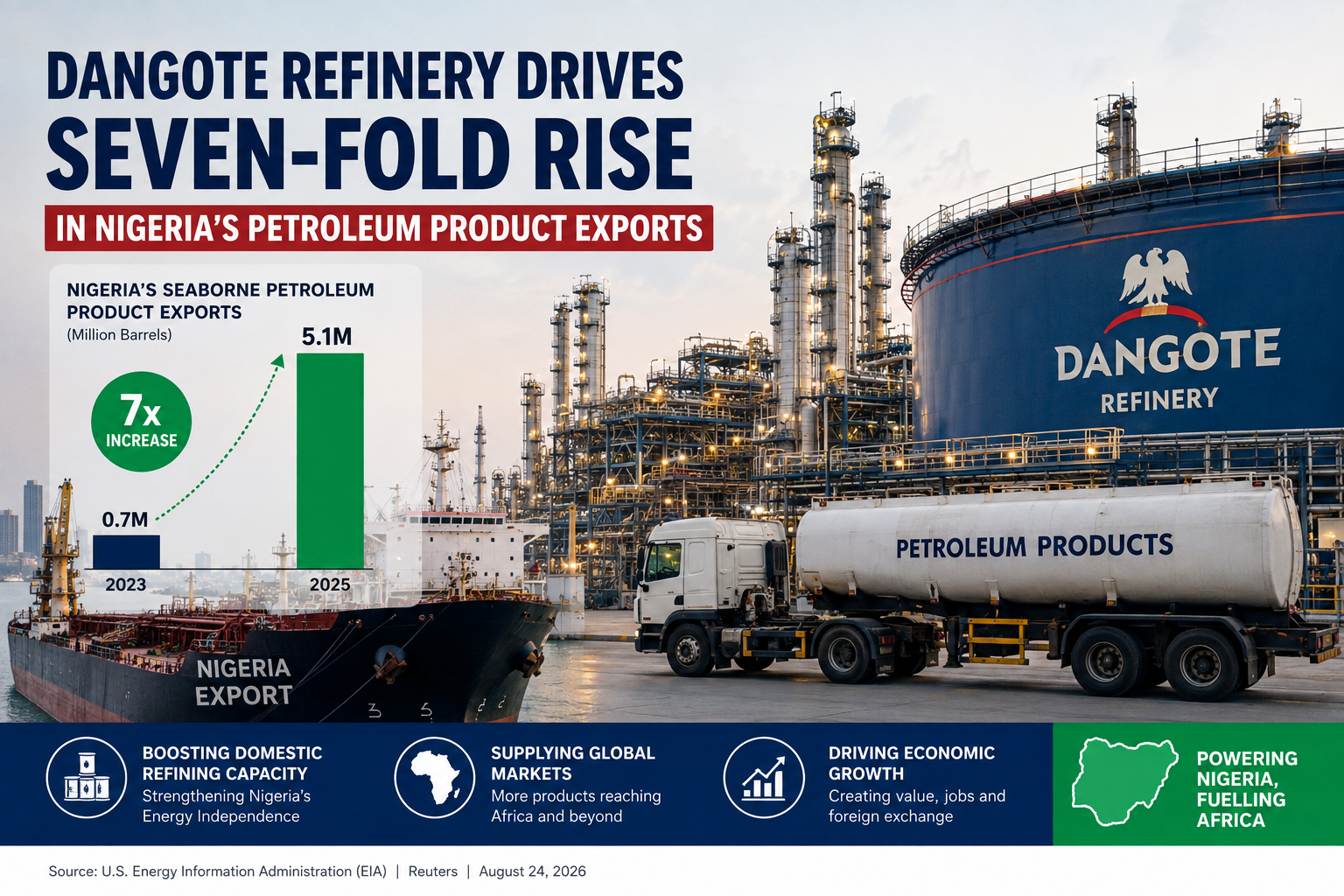
August 25, 2026 | GlobalEcho247 News Desk | Lagos, NigeriaNigeria’s petroleum industry is undergoing a major shift as production from the Dangote Refinery has helped drive a seven-fold increase in the country’s seaborne petroleum product exports since 2023, according to data cited by the U.S. Energy Information Administration (EIA).
The development highlights the growing importance of domestic refining capacity to Nigeria’s position in the regional and international energy market. Reuters reported on August 24 that the refinery’s output has significantly increased fuel supplies available for markets across Africa and Europe.
The expansion of refined-product exports represents a significant change for Nigeria, traditionally one of Africa’s largest crude-oil producers but historically heavily dependent on imported refined petroleum products.With the Dangote Refinery increasing production, Nigeria has greater capacity to process crude domestically and supply refined products to neighbouring African markets. The development could strengthen the country’s role as a regional petroleum-products hub while reducing some of the supply pressures associated with dependence on imported fuel.
The refinery’s growing output also comes at a time when Nigeria is seeking to increase domestic value addition across its oil and gas sector. Rather than exporting crude alone, increased domestic refining allows more economic activity to take place within the country through processing, logistics, distribution and related industries.Analysts will be watching whether the expansion can be sustained and how it affects domestic fuel prices, government revenue, foreign exchange demand and Nigeria’s broader energy-security objectives.
For Nigeria, the rise in refined-product exports represents more than an increase in trade volumes. It signals a potentially important transformation in how the country participates in Africa’s energy economy.Source: Reuters, citing U.S. Energy Information Administration data.